

ANALYSISTRANSPORT & LOGISTICS
AI in Transport & Logistics: Half the Adoption, Twice the Pressure
Transport uses AI half as much as the average economy, while failures and the driver shortage squeeze the sector. Six documented use-case families and five 90-day decisions to join the first movers.
The industry born of optimization is the last to equip itself
Let us start with the paradox that structures this whole report. Transport and logistics are, historically, the industry of optimization: routing, load factors, scheduling — the trade consists of doing more with the same trucks. Yet this is precisely the sector that adopts artificial intelligence least. In the United States, 7.9% of transportation and warehousing businesses report using AI, versus 23.2% on average across all sectors (US Census Bureau). A one-to-three ratio — and it is not an American anomaly.
Europe reproduces the same gap, one level up. In the Union, 11.15% of transport and storage enterprises used AI technologies in 2025, against 20% of all enterprises (Eurostat). In France, the official sector cut gives 9% for transport and warehousing, versus 18% across all companies (INSEE). Three geographies, three statistical institutes, one proportion: transport uses AI half as much as the rest of the economy. The general movement, meanwhile, is accelerating everywhere — 26% of enterprises use AI in Germany (Destatis), and around 35% in the UK by mid-2026, nearly triple the 2023 level (ONS).
One gap, three continents: transport adopts half as much as the average
One point of honesty is needed, and it changes the reading: this lag is closing fast. In the European Union, the sector's adoption rate has more than doubled in two years — 5.26% in 2023, 8.13% in 2024, 11.15% in 2025 (Eurostat). The starting line is low, but the slope is among the steepest in the economy. For a transport or logistics executive, those two figures tell the same story from two angles: most of your competitors have not yet structured their approach — and that situation will not last.
The paradox is only apparent, and understanding it helps escape it. If the industry of optimization equips itself so slowly, it is not out of indifference to efficiency — it is because its data is more fragmented than almost any other sector's: a TMS here, telematics there, delivery notes still on paper, thousands of quoting emails, and part of the know-how in dispatchers' heads. Yet every documented success in this report starts from the same asset: consolidated operating data. That is the common thread of the six use-case families we will examine below.
Margins under pressure, trucks without drivers
This equipment lag would be anecdotal in a comfortable industry. It is not one. Across Europe, about 502,000 driver positions are unfilled, representing 13% of the workforce, and two operators in three say they turn down contracts for lack of drivers — while 660,500 drivers will retire by 2030 (IRU). The pressure on capacity is already continental.
In France, this tension is compounded by severe economic pressure: 645 freight transport companies disappeared in the second quarter of 2025 — about ten per working day, up 55% over two years, the worst toll since 2020 (Union TLF). Transport and warehousing weigh heavily — more than 1.5 million employees at end-2024, nearly €267 billion in turnover, and total transport expenditure of €536.8 billion (SDES); counting the full industry chain, about 10% of GDP and 2.1 million jobs (Union TLF). That weight rests on structurally thin margins that the cycle is squeezing further: the sector is losing companies from below and capacity from above.
In France too, demand is deforming more than weakening. French e-commerce reached €196.4 billion in 2025, with 3.2 billion transactions (+11%) — and nearly one delivery in two now goes through out-of-home modes, pickup points and lockers (Fevad): more fragmented flows, more parcels, denser rounds to orchestrate. For the executive, the conclusion of this picture is arithmetic: when capacity is scarce and margins compress, every empty kilometer, every hour waiting at the dock and every lost quote costs more than before. That is exactly AI's home turf — and that is why the sector's adoption lag is an anomaly that will correct itself, with or without you.
Half the AI of the average economy, twice the pressure of most sectors: that gap is a decision waiting to be taken.
Plenty of experiments, almost no strategies
Where AI has entered logistics organizations, the problem has changed in nature: it is no longer about trying, but about structuring. 71% of supply chain professionals say AI is transforming their chains, and 48% rate its impact as significant or greater — a 25-point jump in one year (MHI / Deloitte). But among organizations that deployed AI in the past twelve months, only 23% have a formal strategy; the majority proceeds project by project, with no framework and no measurement (Gartner). The experimentation is there — the method is missing.
And the coming generation of tools will not leave time to drift. Spending on supply chain software with agentic AI — agents that quote, book, call and reschedule on their own — is expected to grow from under $2 billion in 2025 to $53 billion by 2030, with the share of user companies rising from 5% to 60% (Gartner); 70% of large organizations are expected to have adopted AI-based demand forecasting by then (Gartner). Leaders are already drawing the social consequences: 55% expect agentic AI to reduce entry-level hiring, and 51% anticipate overall workforce reductions (Gartner) — a prospect to handle with care in a sector that is, at the same time, looking for half a million drivers.
Experimentation without method — and the wave coming
This contrast — an under-equipped sector, tools industrializing at speed — defines the useful question for a transport or logistics executive committee. It is not "should we go", nor even "when": it is "through which use-case family, with what data, and with what measurement discipline". The rest of this report answers it with documented deployments — from the American giants to French carriers and parcel operators.
Six use-case families, one common logic
The deployments carried through in the sector outline six use-case families, sharing three traits: the task is repeated at very high frequency, its current cost is measurable, and the improvement translates directly into kilometers avoided, hours saved or capacity recovered. The point of reviewing them is not to collect them — it is to recognize the one that matches your situation, and the state of data it requires.
Route and network optimization. This is the founding family — the one whose proof the sector itself wrote. UPS's ORION system, deployed across some 55,000 daily routes, saves on the order of 100 million miles and 10 million gallons of fuel per year, worth $300-400 million in annual savings — figures published as early as 2016-2020, before the current AI wave (UPS). The mechanics hold at every scale: Geodis cites +10% parcels per truck at a French retail client through load-fill optimization, and 10-15% fewer vehicles on its German pharmaceutical network steered by a digital twin (Geodis). And last-mile precision is becoming an asset in itself: Amazon's generative mapping has matched 2.8 million apartment addresses to the right building and identified parking for 4 million addresses (Amazon).
Freight quoting and pricing. This is the fastest-moving family, because the raw material — the inbound email — already arrives by the thousands every day. At C.H. Robinson, generative-AI agents read requests, quote and book appointments: more than 3 million shipping tasks executed without human touches, about 10,000 automated transactions a day, and load acceptance in under 90 seconds where manual processing took up to four hours (C.H. Robinson). Uber Freight has moved $1.6 billion of freight through its AI infrastructure in twelve months, with more than thirty agents integrated into the TMS (Uber Freight); Kuehne+Nagel is industrializing spot pricing in air freight (Kuehne+Nagel). In a business where the first to answer wins the load, quoting speed is revenue.
Customer service and visibility. This is the family where France has just published one of Europe's clearest cases. Chronopost's autonomous agent — an evolution of the Leonard chatbot, built with ILLUIN Technology — understands requests in natural language, triggers corrective actions and resolves 85% of requests end-to-end without a callback, with responses 40% faster and satisfaction on par with human advisors across more than 100,000 test calls (Chronopost). UPS targets 98% of customer-service requests handled by AI assistants by end-2026 (UPS); DHL is deploying voice agents worldwide for carrier appointment scheduling and status calls (DHL); Maersk is equipping 450 vessels to sharpen the smart monitoring of its refrigerated containers (Maersk). The customer no longer buys mere carriage: they buy the answer to "where is my parcel, where is my container".
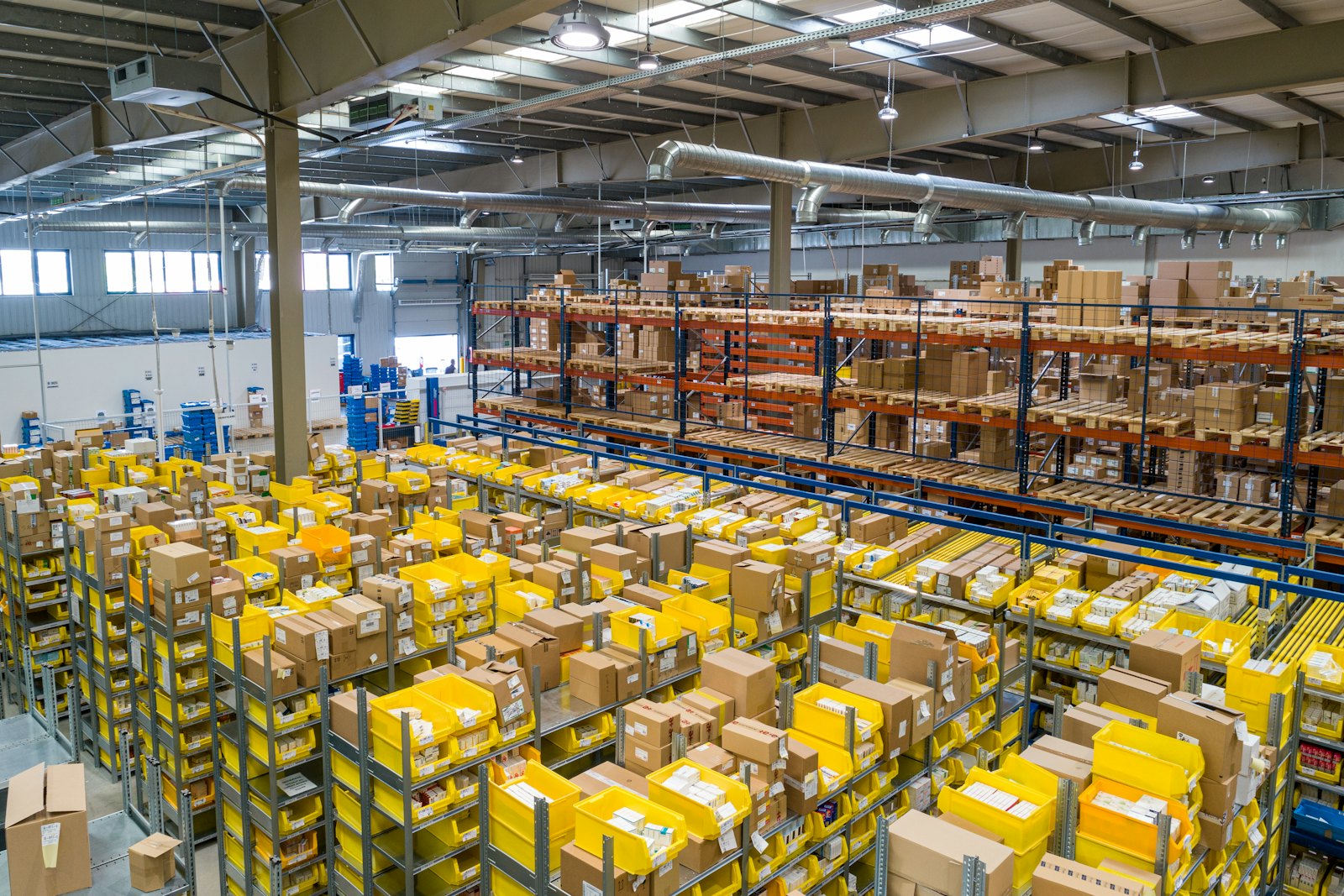
The warehouse. This is the family of volumes — and the reserve remains vast: about 26% of the world's warehouses will be automated by 2027, which means three warehouses in four still are not (Interact Analysis). The majors' trajectories show what is at stake: Walmart targets 65% of its stores supplied by automated centers with unit costs improved by about 20% (Walmart); FedEx has Dexterity's dual-armed robots loading trailers, moved from pilot to operational scale at its Hagerstown hub (FedEx); DHL is adding a thousand robots to its UK operations alone (DHL); JD plans 3 million robots over five years (JD.com). The effect grows with the flows — a second-stage workstream for a mid-sized player, a first-stage one for a multi-site network.
Forecasting and capacity. This family attacks the sector's most expensive problem: sizing scarce assets. The cross-industry references bound the gain — forecast errors cut by 20 to 50%, warehousing costs by 5 to 10% (McKinsey) — and the first movers have taken a measured lead: logistics costs improved by 15%, inventory levels by 35%, service levels by 65% versus slower competitors (McKinsey). The field confirms it at every scale: Dachser forecasts its branches' inbound volumes up to 25 weeks ahead from its shipment history (Dachser), and Amazon's new forecasting models gain 10 to 20% accuracy depending on the horizon (Amazon). The prerequisite is always the same: a clean operating history, at route and customer level.
Documentation and customs. This is, finally, the most discreet family and one of the most profitable, because transport is a business of paperwork: consignment notes, declarations, claims, tenders. Maersk launched an AI-powered customs platform on an eloquent market finding — 5 to 6% of customs duties overpaid on average, 20% of shipment delays tied to poor document preparation (Maersk). Kuehne+Nagel has its Claire assistant prepare declarations (Kuehne+Nagel); DHL has generative AI draft proposals and summaries (DHL); Geodis pre-fills 80% of its tender responses (Geodis); and CMA CGM has committed €100 million over five years with Mistral AI, customer claims and document management first (CMA CGM). Europe's standardization of freight data — the eFTI regulation — will make this material even more exploitable: structured data is the fuel of every family above.
Two speeds of return — and what conditions them
Six families, one common thread: consolidated operating data. The carrier that structures it serves its customers, its dispatchers — and becomes readable by the agents that will allocate tomorrow's freight.
The proof, in French
The classic objection — "these are American giants' results" — no longer holds. French transport and logistics players now document their own deployments, under the same rules as everywhere else: a narrow scope, prepared data, a measured result. Four recent cases suffice to show it.
Taken together, these cases sketch the profile of the deployment that succeeds at French scale: none starts with frontier technology, all start with the data asset that already existed — service calls and messages at Chronopost, freight documents at CMA CGM, the operating history at Geodis, instrumented wagons at Rail Logistics Europe. The entry step is not capital-intensive: it is organizational.
The regulatory rail: compliance is part of the costing
This equipment lag would be anecdotal in a comfortable industry. It is not one. Across Europe, about 502,000 driver positions are unfilled, representing 13% of the workforce, and two operators in three say they turn down contracts for lack of drivers — while 660,500 drivers will retire by 2030 (IRU). The pressure on capacity is already continental.
In France, this tension is compounded by severe economic pressure: 645 freight transport companies disappeared in the second quarter of 2025 — about ten per working day, up 55% over two years, the worst toll since 2020 (Union TLF). Transport and warehousing weigh heavily — more than 1.5 million employees at end-2024, nearly €267 billion in turnover, and total transport expenditure of €536.8 billion (SDES); counting the full industry chain, about 10% of GDP and 2.1 million jobs (Union TLF). That weight rests on structurally thin margins that the cycle is squeezing further: the sector is losing companies from below and capacity from above.
In France too, demand is deforming more than weakening. French e-commerce reached €196.4 billion in 2025, with 3.2 billion transactions (+11%) — and nearly one delivery in two now goes through out-of-home modes, pickup points and lockers (Fevad): more fragmented flows, more parcels, denser rounds to orchestrate. For the executive, the conclusion of this picture is arithmetic: when capacity is scarce and margins compress, every empty kilometer, every hour waiting at the dock and every lost quote costs more than before. That is exactly AI's home turf — and that is why the sector's adoption lag is an anomaly that will correct itself, with or without you.